Showing posts with label Kyoto. Show all posts

Sunday, July 12, 2015

MAP OF CLASSIC KYOTO SWEET SHOPS

I have begun creating a map of classic Kyoto Sweet Shops and would like folks to add to it. I'm not being very fancy at this point, but would like to ultimately have an annotated description (images, history, etc.) of the great sweets that have accompanied chanoyu over time. All submissions are welcome.  Here's the link.
The list to date includes:
Arashiyama Asatsukicho
Chogoro Mochi Hompa
Kaigen
Kamehironaga
Kameya Kiyonaga
Kameya Norikatsu
Kamihoritsumecho
Kanshundo
Kashiwaya Mitsusada
Kawabata Doki
Kogetsu
Kyo Namagashi-shi Matsuya
Kyoukashitsukasa Kameya
Malebranche
Nijo Wakasaya
Oimatsu
Otabe (various locations)
Ryuen
Shiryokan
Shogoin
Suetomi
Surugaya
Tamaruya
Tawaraya Yoshitomi
Tsuboneya
Tsuruya Yoshinobu


Tuesday, May 19, 2015

SASAKI SANMI: A MAN FOR ALL SEASONS


Chado The Way of Tea: A Japanese Tea Master’s Almanac
By Sasaki Sanmi
Translated by Shaun McCabe and Isasaki Satoko
(Boston USA, Tuttle 2002)

REVIEW BY LAUREN W. DEUTSCH
KYOTO JOURNAL 54

Tuttle Publishing, the New England / Tokyo bookmaker who has been keeping the sumi smoking for Okakura Tenshin’s Book of Tea seemingly forever, has recently snapped out of an all too long pop culture daze to help circulate some of the Japanese culture classics in English translation. Their reissue (In larger format facsimile) of A. L. Sadler’s Cha-No-Yu The Japanese Tea Ceremony (first published in 1933) is welcome simply for the fact that the print is now about 10 point, almost a 30% increase. Tuttle issued in 2001 a translation by Kyoto garden experts Marc Peter Keane and Jiro Takei of the millennium-old Sakutei: Records of Garden Making  by a Japanese court noble, considered the oldest book on gardening in the world.

And now the piece d’ resistance … Sasaki Sanmi’s Chado, a humongous volume of translation of the 20th century tea master / journalist / intellectual who spent a great deal of effort (must have) writing down what to the rest of us was mandated as “oral transmission”. How this man secured permission from his patrons, the Sen Family (the book has a Forward by Urasenke's Hounsai Oiemoto, Sen Soshitsu XV), to put down this material into writing and publish it may be the only stone left unturned.

Although he wishes us to read it like a novel, a story, it’s most easily penetrated with an indiscriminate finger looking to get away from the mundane by taking a little sojourn into an idyllic world, where everything is just perfect. Perfect in the way the Japanese tea folks can do perfect. That “casual” perfect which make it look like everything just simply happened. Finally the code is cracked into English.

Unlike The Farmers’ Almanac, the American classic booklet (in comparison) which is a handbook on working with  or around the forces of nature in the buff (nature, that is), this accounting of correspondences, reflections and references, is more a study in how nature must be. (There is no hope for someone who can’t resist buying a flocked pink pine Christmas tree in the desert.) One might say there’s no room for weeds, but in fact there are appropriate weeds as well. (I knew that.)

The confidant of the 14th Generation oiemoto (grand master) Tantansai of the Urasenke tea school, Sanmi (1893 – 1969) informs one’s effort toward deep appropriateness by using the device of listing to build a case for ambiance, much like the authors of Tale of Genji and The Pillow Book.

There are 12 chapters, one per month, listing in nine sections of myriad features ( utensils, poetic references, events, memorial days, flowers and weeds for tea, cakes, cuisine and foodstuffs, words and meisu, just lists and more lists of related this and thats). It leaves nothing unaccounted for: consider holding a lovely July asachaji (early morning tea gathering) … For the haboki (a feather brush used to dust the hearth from wayward ash during the charcoal laying rituals), “Do not forget the idea of using the feathers of a light red heron, a snowy heron or silver pheasant.”  (You have been warned.)

Sanmi’s text is narrative as well, a boon for neophyte tea students wrestling with the haiken (inspection) of utensils, as much as it is for the masters who are looking for a new theme for a new moon viewing chaji. We have a sense that all is quite lovely indeed.

The translators profess to not be poets, and this reader cannot vouch for their accuracy or sensitivity in this account as she cannot read the original. It must at least be “accurate” as the Oiemoto would never agree to participate in a project if it were not. One bi-lingual tea teacher commented that the language is much too pretty. Another chajin took issue with the selection of an image of yet another geisha making tea on the cover.

Enough with this premise that tea is frozen in time and space.  But, now with this book, chado in the hands of the unJapanese, it is anything but that at all. We are grateful.


Monday, May 18, 2015

Review: Karesansui and the “ineluctable and illuminative thread”
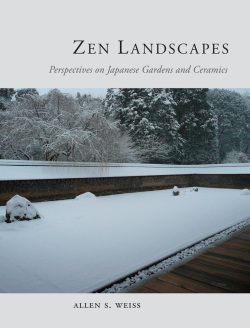

Karesansui and the “ineluctable and illuminative thread”

KYOTO JOURNAL 82 REVIEW BY Lauren W Deutsch
9781780231907
“To begin with a chawan in the palm of one’s hand and end up imagining a garden, poem or painting reveals the richness inherent in Japanese culture.”
— Allen S. Weiss
When I began to study chado, the Japanese “way” of tea, this left-handed, Jewish American woman wondered whether there was a hidden agenda or symbolic meaning in the movements of the utensils from point a to point b … to point n. Since the ritualized presentation of chanoyu—literally preparing hot water for tea — flourished during the Momoyama period when the daimyos were waging war with each other, I mused: Perhaps the mizusashi (fresh water container) and kama, (kettle) stood for the castles of feudal lords, and the many codified arrangements of other utensils referred to battle strategies, much like the Xs and Os of a football coach outlining a play. Or maybe connecting the utensils’ footprints on the tatami mat in a particular order revealed a secret kanji code. It’s not far fetched; supposedly the siting of Japan’s colonial headquarters in relationship to city gates and palaces branded the map of Seoul with thekanji for “Dai Nippon,” Big Japan, which surely would have been thought to affect the geomancy. However, I was wrong in all cases. It didn’t make “sense” in Western terms, yet, I learned, there is great “sense” to be made out of all of it.
Over time as a student of a master teacher, the inherent integrity of the practice of this most Japanese of Japanese cultural complexes began to reveal itself in many more ways than just making a proper bowl of matcha, Japanese powered green tea leaf. The rigors of the lesson began to creep out of the tearoom and into the larger sphere of every day life. My senses began to incline toward jaku, (tranquility), born of harmony, purity and respect—wakei and sei in Japanese. Without the benefit of any capacity to read Japanese, I loosely defined the term temae, the procedure for ritualized making of tea for the guest, as to just undertake the matter at / in front of (mae) one’s hand (te). It seemed that I had inadvertently bumped into the refined “metaphoric and synaesthetic imperative” that forms the foundation of Japanese “aesthetics, ethics and epistemology”, to quote Allen S. Weiss, author of Zen Landscapes: Japanese Gardens and Ceramics.
Thus, it was with great pleasure that I had the opportunity to read Professor Weiss’ exciting new book, one that is just as much a significant contribution to the growing English-language library of volumes about the influence of Zen-steeped chado on the Japanese mindscape as it is about the creations of ceramic objects and fertile, well-cultivated verdant spaces—i.e. the “land”scapes promised in the title. He, too, experienced bewilderment about the “sense” made by Japanese aesthetics until further immersion.
The reason Weiss wrote this book is that, upon finally visiting Kyoto’s 15th-century Ryoanji karesansui – literally dry /mountain / water dry stone garden, he felt that everything he had read about it paled profoundly in comparison to being there. In fact, Weiss, an acknowledged expert in the gardens of Versailles, reframed his assumptions about landscape in general. “I immediately suspected that my disorientation went far beyond mere culture shock,” he shares. The more he explored other areas of Japanese culture the more he realized that such gardens and other art forms—especially tea ceremony, ceramics and kaiseki cuisine—were connected by an “ineluctable and illuminative thread,” Zen Buddhism and thus become a holistic cultural experience that is greater than the sum of the parts.
Early in his text he offers a thorough discussion of the often cited but too-often misunderstood aesthetic qualities of wabisabi and shibui, attributes popularized through the spread and institutionalization of chanoyu that now crop up in other art forms. “Both aesthetics and connoisseurship in Japan are informed by these complex existential and conceptual matrices,” he comments.
Weiss explores both the performative and material nature of chanoyu that enables the reader to understand the point of the ritualized experience: to heighten the senses of the guest that will serve her long after she leaves the chashitsu, the rustic hut-like tea room. The guest not only takes full advantage of the host’s hospitality, she literally imbibes those ubiquitous Japanese sensibilities. Further, by drinking matcha from the roughly fashioned hand-made ceramic vessel, the guest is also in communion with the potter who crafted it. Likewise, Nobel Prize winning author Kawabata Yasunari weaves his storyThousand Cranes around a white Shino chawan, by giving it significance and utility far beyond its being used as a vessel for holding a beverage.
Discussing the nexus of Japanese aesthetics on the material plane, Weiss notes Japan’s ceramic and garden arts owe their substance to the “macrocosmic five elements of the Japanese Shinto / Chinese Taoist cosmos”: fire, wood, earth, metal, water. An entire cosmos may be perceived in the colors and textures of a patch of glaze on a chawan, tea bowl or a weathered wall surrounding a garden. This illustrates the first of nine maxims of his “Manifesto for the Future of Landscape”. (See sidebar.) Even further, he observes, “… the cosmos can be compressed into the form of a small garden, the garden reduced to the disposition of food on a plate, and the plated “landscape” represented by the patterns on the plate or guinomi (ceramic sake cup).” His divertisement about kaiseki cuisine adds another hint about his diverse and extensive aesthetic range.
As a grain of sand might be compared to a rock, for his discussion on ceramics, Weiss focuses on the guinomi, a proportionately identical but miniature version of the chawan. (Similarly, the 1 : 2 ratio of dimensions of a tatami mat may be found expanded and reduced throughout Japan, from a folded kimono to an entire building.)
To this end, his choice of highlighting the guinomi enables him to cite the huge diversity of effects produced from the past to today by Japan’s 100 major and over 50,000 minor kilns without being subject to the rigors of the strict chanoyu system. Weiss explores evolution of ceramics in Japan with ample examples from the venerable functional work of the Raku clan over the past 15 generations to non-functional creations by independent contemporary ceramic artists who incorporate mass production, “damaged” and found objects. He discusses how the variety of fuel used in the kilns and other site-specific characteristics and can import a “clay flavor” to a cup. Through his examples, one can see how collaboration of human and elemental nature that create “pottery landscapes,” including superficial traces of minerals and cracks that give a work its character, is also evident in the earthen walls, plantings and stone settings of Japanese gardens.
While a pebble is not a rock, nonetheless Weiss allows that “Representation implies both abstraction and metaphorization, such that—just as the qualities of each morsel on a plate are enriched by the adjacent foodstuffs—the profundity of metaphor depends on both the specific beauty of each of the terms and the vast range of qualities that simultaneously link and separate them.”
Throughout the text, Weiss sets up scenarios, ‘scapes, that unfold in Japan’s refined, concentrated garden spaces that nonetheless expand in the mind, no matter how large or small they may be, whether one strolls through, dangles feet from a verandah or sits on one’s heels on tatami mats. Each of the three basic styles of Japanese gardens—dry, stroll and borrowed scenery—depends upon the serendipity that comes from working with natural materials and on “a powerful sense of enclosure and threshold,” to quote Andrew Todd.i
While seemingly frozen in time, the karesansui gardens in fact have constantly evolved not only throughout history and as a result of the impact of the weather and other natural forces on the garden elements, but also are constantly changing as a result of the viewer’s vantage, including the disposition of the mind and the position of the body. In terms ofchanoyu, the phrase is ichi go, ichi e. This one moment can never happen again.
Weiss, a scholar, author and producer of numerous performing art forms and film, serves up provocative ideas and stimulating questions about what “happens” in these “empty” spaces. The eminent theatre director Peter Brook, provides a hint: “The stage is a place where the invisible can appear….”ii The role of the visitor to Ryoanji or any venerable Japanese garden is more likely that of a participant in theatre, neither uniquely audience member nor actor. The typical visitor to Ryoanji sits on the wooden veranda of the head priest’s quarters and, too often, begins by engaging the view of the garden from the mundane mind/body: counting the nameless rocks that jut above / nestle within the field of raked pebbles. While it is said that not all 15 rocks can be captured in a single visual frame, Weiss notes the one vantage from where this can in fact happen. (I relied on Google Earth: 35° 2’3.90″N, 135°43’5.50″E!)
The hidden presence of objects in spatial context is also found in other aspects of Japanese culture. “The extraordinary discretion of Japanese connoisseurship demands that very few objects be visible at a given time, and that an important work of pottery will be seen but rarely,” Weiss notes and references Junichiro Tanizaki, author of the seminal essay In Praise of Shadows.
But as tempting as it is for the average visitor to “waste” precious time counting rocks, or musing on how the gardeners leave no footprints while raking the pebble patterns, the participant might take the opportunity to find herself incorporated into the patterns as they “flow” around rocks, and are confined by the surrounding walls. The totality of the scene requires the witness to complete the scenario, adding the “missing” piece of the puzzle from her very being. Yoshi Oida, a long-time member of Brook’s theatre group has a helpful question for the garden visitor: “The space asks the actor, ‘Who are you?’ It asks this directly to the being, the personality of the actor.”iii
Weiss also generously posits engaging queries such as, if one of the rocks split, would that increase their number? He recalls the story about how the American music composerJohn Cage used the image of the placement of Ryoanji’s rocks as notes for a musical composition by the same name. Unlike gardens with extensive greenery, Weiss propose that the stones neither grow nor die; this is the “job” of the moss. Other changes of the garden are products of the seasons, such as snowfall, the growth of opportunistic foliage such as moss, or a leaf dropping into the midst. And, if no one is there to witness that leaf falling …
Perhaps the ultimate abstraction of a Japanese garden is the Noh stage. Constructed of natural timber the stage includes four posts, reminiscent of trees, with a kagami-ita, backboard, upon which is painted an oi-matsu, pine tree. In this rarefied “garden” kami(Shinto gods / spirits) come and go, interact with each other, and remind the audience of their ubiquitous presence in the theatre in every day life.
“I am convinced that especially in Japan all of the arts share a common aesthetic basis,” Weiss noted in recent correspondence with me. Through his guidance, it is possible to imagine seeing the mountain in the distance from the edge of a chawan, or from a distance cupping ones hands around the tsukubai, stone water basin emblematic of roji(teahouse gardens). I am convinced that this book, too, is a garden, a theatre, and a vessel in which one may fully explore the integrity and vitality of that which we call Japanese culture that we are lucky enough to experience.
Footnotes:
i Andrew Todd and Jean-Guy Lecat, The Open Circle: Peter Brook’s Theatre Environments. (New York, Palgrave
Macmillan, 2003)
ii Peter Brook, The Empty Space (New York, Simon and Schuster, 1968)
iii Todd, Lecat, op. cit.

Saturday, May 2, 2015

It’s a Family Affair ... RAKU: A Legacy of Japanese Tea Ceramics


By Raku Kichizaemon XV and Raku Atsundo
Edited by Melissa M. Rinne.
Translated from the Japanese by Christopher Stephens, Melissa M. Rinne, Martie Jelinek, Juliet Winters Carpenter, Christy Bartlett and Maya M. Hara
Kyoto, Raku Museum / Seigensha 2015

Review by Lauren W. Deutsch for Kyoto Journal

The publishing of this wonderfully designed, useful English language catalog that documents the unbroken 450 years-old legacy of handcrafted ceramics by THE Raku family [and friends, see below] was timed to coincide with the landmark exhibition – RAKU:  The Cosmos in a Tea Bowl --  of nearly 100 masterpieces of ceramic art with representations of the work by all 16 generations of the Raku family tradition at the Los Angeles County Museum of Art (and afterwards at the Hermitage Museum in St. Petersburg and Pushkin State Museum of Fine Arts in Moscow.) in 2015. Robert T. Singer, curator, and LACMA’s head of Japanese Art, championed the exhibition in concert with the much - decorated Raku Kichizaemon XV, head of the Raku Museum in Kyoto and designated (1986) a Living National Treasure of Japan attended the opening.


The book is foremost an illustrated chronology of some 206 ceramic works attributed to all of the Raku masters, with biographies of the artists. An addendum clearly shows photographs of box lids and translations of inscriptions and provenance. Thus, it is an essential tool to use when deeply exploring the exhibition at home in Japan as well as on the road in the USA and Russia. It contains not only extensive notes (in English and kanji) about the pieces, but through the photographs one can see details some of the nuances that each generation contributed to the oeuvre of the esteemed “house”. RAKU is a valuable addition to a chajin’s library, even without the benefit of being in the august presence of the exhibition’s two Registered Important Cultural Properties: a chawan from each of Chojiro, (here called Raku I) and another by Raku III (Donyu), and a Registered Important Art Object by Nichiren (Hokke) coreligionist / calligrapher best friend Hon’ami Koetsu. I was impressed by the relatively small size of the exhibited chawans that seem to get just a bit bigger over successive generations. Was it because people’s hands grew?

The essays – whose specific attribution of authorship is not detailed despite the use of the first-person-singular -- include photographs of rare documents that form the basis of the anecdote-rich family and national cultural history. We learn about the painstaking efforts to pinpoint Chojiro’s roots – dead-reckoned toward China -- and a cast of other venerable successors who begat, married into, etc. to creat a definitive singular succession of masters, one per generation, to this day. Of course, this being the definitive volume on Raku, the uniquely non coiled hand – hand built functional ceramic style, we are given the opportunity to realign our understanding of the journey of each of the artists, their influences and impact over 16 generations.

Proper homage is paid to Chojiro’s muse, his contemporary, the venerable tea master Sen no Rikyu, whose official family tree has sprouted and been spliced with branches wherever fine Japanese “high” culture landed until the present time. But when- and wherever Raku was, so was tea and vice versa. There was a dialogue between contemporaries from the start. Great emphasis placed on discussion regarding Chojiro’s developing the “spirit of imayaki”, the “now” ceramics. One can see how that works well with Rikyu’s wabicha, equally informal and essentially ichi-go. Ichi-e, one meeting, never to be repeated. He also takes liberty to project that the essence of Rikyu’s conviction to commit his final act of seppuku at the insistence of the Shogun Toyotomi Hideyoshi could somehow be intimated by holding Chojiro’s chawans.

Unlike other artisanal enterprises, including other ceramic styles, and despite the propensity towards the technique / style evolving from the outside into adjectives – from raku to raku-like, Raku prides itself in maintaining the singularity of its head-of-house as the only producer of its works; there are no contemporaneous students or schools that are recognized, as the book details through text about other kiln sites. There is also an extremely valuable chart of recognized seals of the Raku masters and some other raku-ists.
What impresses me more is that successive Raku generations are not “taught” by the previous one. The three-step mastery process shuhari is described as 1/ learning the basics (shu), 2/ breaking with conventions to express oneself (ha) and 3/ finally transcending hte inherent contradictions between convention and consciousness to find true freedom of expression (ri). One almost gets the feeling that the existence of the head Raku of any generation lives and works in relative isolation to preserve the essence of his creative spirit through the length of his days. Another Raku maxim is onko chushin, literally, “warm to the old, know the new”. A video of Kichizaemon, making a chawan may be found online. One can see him going into a zone that seems to begin with his hand caressing the clay. This clay may have been drawn and processed for him by his grandfather, Raku XIII, Seiynu. in the tradition of each generation preparing clay for two ahead.
I remember being generously invited into the workroom / studio of Onishi Seiwemon, head of the famed and only remaining Kyoto cast ironworks that makes chagama, one of the Senke Jusshoku, 10 Senke Craft Associations. What impressed me most were the clearly well-worn dies, and patterns for kettles for tea ceremony that were on his drafting table. These crafts people not only inherit names, they also become chief stewards of facilities, relationships, prestige and fine examples of works from the past prestige, but also handle the very tools that brought them to this moment in time.
In addition to chawan and other chadogu, the book and exhibition offer other examples of work, including incensers, plates, flower containers and other objects. There is much discussion also about the fundamental aesthetic qualities of Chojiro’s “Two-color Glazed Lion” that provide “important signals which presage the subsequent development of the Chojiro tea bowl.”
Another essay goes into the layout of the Raku production facilities and techniques, such as the identity of the fuel, and use (or not) of bellows, as well as sources of clay and glaze materials. I now wish I had done a little digging along the banks of the Kamo River for a souvenir! To further the notion that each generation must make his own mark in a succession of artistic tradition, it is explained that the Raku enterprise lacks any “definitive recipe books about glazes or clays, leaving each master to discover new ways to “create hitherto non-existent expressions”. We are told, “Raku family does not have any secret hereditary texts.”
“While they inherited Chojiro’s black glaze, they also have the second generation Jokei’s black matte glaze; the third head Donyu’s black lustrous, glossy curtain glaze; the fourth generation Ichinyu’s mixture of black and crimson glazes; the fifth head Sonyu’s black glaze with its lusterless yet refined matte kase finish reminiscent of a metal survae; the seventh head Chonyu’s jet black, lacquer-like surfaces. In this way, the black glazes of the Raku heads f are never the same; each must invent his own individual black glaze within the confines of the medium while questioning the age in which he lives, and distinguishing himself with a unique style.”
Another essay dwells more on wabi and the influences of Zen Buddhism, the “Beauty of Relativity and Yoshida Kenko’s Essays on Idleness, waka poetry, especially the Man’yoshu and later Kokin wakashu.
The “Ultimate Wabi” section, likely written by Kichizaemon, connects Chojiro’s chawans with a discussion of a 1997 European exhibition of Raku ware and another where he explores his instinctive connection with the sensibility to the work of Mark Rothko, Yves Klein and Marcel Duchamp.
“I cannot but feel that Duchamp, the mother of modern art, and Chojiro, who drowns his tea bowls in black glaze, must have shared similar viewpoints,” adding,“ The totality of Chojiro’s tea bowls transcends all types of language and cognition.”

The book ends with information about the Kyoto-based museum and Raku Kichizaemon Pavilion at the Sagawa Art Museum.

A great companion to this book is Morgan Pitelka’s Handmade Culture: Raku Potters, Patrons and Tea Practitioners in Japan. (Honolulu. University of Hawai’i Press. 2005.) Here I was able to learn more that  many tea masters enjoyed making raku-style chawans for their own use, sometimes in backyard kilns and other times in the ceramic master’s studios. Pitelka delves deeply into the social, aesthetic and economic impact of patronage on the production of raku wares. Further he explores in depth the evolution of cultural “households” in Tokugawa Society, and much more about chado’s Iemoto system and its relationship to the Raku family. Like Raku, he also writes about the expansion of raku technique through the establishment of kilns in the West.