Showing posts with label Raku. Show all posts

Tuesday, December 26, 2017

Senke Jisshoku - 10 Craft Families of Three Sen Lineage Holders 千家十職 Part 2


Senke Jissoku is a now well-recognized name of a group of 10 multi-generation famlies that have a closely working relationship with the 3 (san) Senke families that trace their lineage directly to Sen no Rikyu: Mushakouji Senke, Ura Senke and Omote Senke. While there are many other craftspeople whose work has long or even more recently been patronized by these tast-makers, as well as other chanoyu lineages that have patronized the craftspeople, these 10 are formally afforded a special relationship as a group in formal ceremonies and death anniversaries of past Senke grandmasters. The number of craftsmen (usually male lineages) used to vary depending on the family branch, but this distinction came about as a result of a group exhibition staged by and at the Mitsukoshi Department Store branch in Osaka in the Meiji period (1919).

Raku Kichizaemon X V 樂吉左衛門 
Chawanshi (potter for chawan and other ceramic ware) 茶碗師

(Interesting that this blog did not have a short paragraph about Raku. This is from the 2016 catalog from the Raku Museum.) 

Raku is one of many low-fired ceramic traditions around the world. It has its roots in Ming dynasty three-colored sosansai) wares from Fujian province in China. The tea bowls fashioned by a potter named Chojiro during the Azuchi-Momoyama period in the last 16th century marked the dawn of Raku Ware. There exists little or not detailed documentation of the relationship between Chojiro and Rikyu; however, Chojiro’s independent creative spirit has been preserved thereaafter throughout generations and centuries of the Raku famly. Each new generation has developed his own distinct style, who;e at the same time honoring the timeless traditions and knowledge handed down from father to son for over 430 years.” The current head of the family is the 15th generation. His son Raku Atsundo is quite productive.
  

Onishi Seiwemon 大西清右衛門 
Kamashi (tea kettle maker) 土風炉師
The Onishi family is a family of Kyoto tea kettle makers, whose work has continued for over 400 years, from the latter half of the Muromachi period. The fourth generation head of the family called himself Seiwemon, and from the sixth generation, excluding the ninth, all subsequent family heads have inherited the name. Their shop is found in the Sanjo-kamanza area in Nakagyo-ku, Kyoto. The current head of the family is the 16th generation of Seiwemon.  
 

Nakamura Sotetsu 中村宗哲
Nushi (lacquerer) 金物
The Nakamura family is a family of lacquerers, whose work has continued for almost 400 years. Originally, they made furniture decorated with gold or silver lacquer (called Tsurei nushi), but starting in the Meiji period they became specialized lacquerers for tea ceremony utensils. In 2006, the second daughter of the 12th generation Nakamura Sotetsu inherited the name to become the 13th generation Sotetsu.  
   

Komazawa Risai 駒沢利斎
Sashimonoshi (wood joinery / carpentry) 指物師
The professional name inherited through the generations by carpenters, who are purveyors to the san-Senke, and who manufacture shelves, incense containers, and fireplace frames, among others. After the death of the 14th generation family head in 1977, the position has remained unfilled for a long time, and currently, Yoshida Hirozo, the son of the 14th generation master's nephew, is undergoing training to inherit the line.


Nakagawa Joeki 中川浄益
Kanamonoshi (hardware maker)  金物師
The name inherited by each generation of the head of the Nakagawa family, a family of hardware makers. Originally, they made armor in Echigo province, but the first generation to try his hand at making tea ceremony utensils, Nakagawa Kojuro, took up the name of Joeki, albeit using different characters, and from the second generation, the same name of Joeki (spelt with the current characters) has been used. The current head of the family is the 11th generation Joeki.


Yuko Tsuchida 土田友湖
Fukuroshi (textile articles, utensil covers) 袋師
One of the ten occupations for Senke. From the second generation, the head of the family is referred to as "Hanshiro", and becomes Yuko when he retires and shaves his head. Up until the fifth generation, they made shifuku (silk pouches for holding tea caddies), but since then, have been making fukusa (small cloths for wiping tea utensils) and sashes for men's kimonos in addition to shifuku. The current head of the family is the 12th Tsuchida Yuko.

Okumura Kichibei  奥村吉兵衛
Hyogushi (scroll mounter and paper products) 表具師

Washi, Japanese paper,  has many applications in the setting of chanoyu. In addition to mounting scrolls, paper is used on doors (fusuma and windows), as well as (pictured) pads of decorative paper used for kami kamashiki (kettle rests). The current generation is the 12th.


Hiki Ikkan 飛来一閑
Ikkanbari saikushi (lacquered papier-mache maker) 一閑張細工師
The name used by ikkanbari saikushi through the generations. The founder of ikkanbari in Japan, one of the types of lacquering, it is a lacquering family that has supplied the Senke through the ages with utensils lacquered in the ikkanbari method, such as tea caddies and incense containers. The current generation is the 16th, and along with the 12th generation of Sotetsu Nakamura, is one of the rare examples of a female head of Senke jissoku.


Kuroda Shogen 黒田正玄
Takezaiku (bamboo crafter) / hishakushi (ladle maker) 柄杓師
The name inherited through the ages by the family of takezaiku / hishakushi. Apart from ladles, they make tea ceremony utensils such as stands, incense containers, and flower vases, out of bamboo, and have delivered their works to the Senke. The current generation is the 13th. They do not make chasen! This would seem to be a huge omission. My informants tell me that it is because one uses a new chasen each time. Seems odd that the iconic utensil for chanoyu is not made by a famous craftsman.
Nishimura (Eiraku) Zengoro 永樂善五郎
Doburo yakimonoshi (potter of braziers) 土風炉師
Ceramic artists adept at making braziers used atop tatami mat and tea bowls. From the first to ninth generations, they named themselves Nishimura, and mainly made braziers that hold charcoal fires. From the tenth generation, they have called themselves Eiraku, and make tea cups in addition to braziers. The current generation is the 17th.

Monday, May 15, 2017

Chawan "All-Stars" & Other Top Tea Toys @ Tokyo National Museum

Not since 1980 have chawan and other National Treasures that were used by / in the collection of Ashikaga Yoshimasa, Oda Nobunaga, Sen no Rikyu and Matsudaira Fumai been together in a single exhibition! 

Welcome to the 21st Century! We’re talking Tenmoku, Oido, Raku, Celadon, Mino, Raku, Shino, works by Chojiro, Hon’ami Koetsu. On exhibition together (with frequent rotation) for a few months at the Tokyo National Museum.

The new tea drinking practices of the Song Dynasty were learned by Japanese Zen monks studying in China around the 12th century and then spread among Zen temples, samurai families, and other members of Japanese high society. These people displayed their status by decorating tea rooms and serving tea with exquisite Chinese artworks called karamono. During the Azuchi-Momoyama period in the 16th century, Sen no Rikyu perfected a new style of tea called wabicha in which Chinese artworks were used together with humble utensils from everyday life, and the tea ceremony spread from the elite of society to lesser lords and townspeople. In this manner the tea ceremony developed over hundreds of years into a prominent and unique aspect of Japanese culture. This major exhibition will focus on how the arts of the tea ceremony evolved from Muromachi period to modernity. This will be the largest exhibition of its kind since Arts of the Tea Ceremony, which was held at Tokyo National Museum in 1980. We hope that by witnessing masterpieces of the tea ceremony from various historical periods, and attuning themselves to the sensibilities of the people who used them, visitors will be able to fully experience the “Essence of Japan”. 

Exhibition Highlights
1. Once-in-a-Generation “Great Chanoyu Exhibition
The exhibition “Arts of the Tea Ceremony” held at the Tokyo National Museum in 1980 (Showa 55) was the first exhibition to present tea utensils from famous collections as Japanese art. Thirty-seven yeas later, we look back at chanoyu, the symbol of Japanese culture, with a fresh eye from a 21st –century perspective.

2. Beloved Tea Bowls of the Famous Generals and Tea Masters
The famed tea bowls once beloved by noted military commanders and tea masters that captures the hearts of people of all periods will be brought together under a single roof. These are first-class ceramics that were made in vastly different regions of China, Korea, and Japan. It is extremely rare for so many masterworks representing every major historical period to be brought together like this in what willl be a truly momentous exhibition.
Vote on your favorite!!!!!
3. From Early Modern to Modern: early modern master who maintained the history of tea tradition
Several of the great industrialists who stood at the center of Japanese economic circles in the Meiji period loved antique arts and thoroughly mastered tea ceremony from a new perspective. Through the eyes of the four figures noted in this exhibition – Fujita Kosetsu, Masuda Donno, Hirase Roko and Hara Sankei – we introduce the new charm of a tea tradition brimming with creativity.

EXHIBITION SECTIONS

Part 1; Tea of the Ashikaga Shogunal Family: Solemnity and Refined Taste in Karamono
Around the 12th century, the new method of tea drinking involving whisking of powerdered tea (matcha) that had been brought from Song-dynasty China gradually spread among  Zen temples and the amurai class in Japan. Tea practitioners collected all manner of Chinese artworks they termed karamono (literally “things form Tang [China]”) and displayed them in interior spaces, as well as using them to enjoy tea in demonstrations of their own status. Then, in the Muromachi period, around the 15th century, the top class karamono objects were gathered together under the Ashikaga shogunal family, especially the 8th shogun, Ashikaga Yoshimasa, where they were classified and appraised by individuals of discerning taste. This high valuation and admiration of imported Chinese karamono objects later came to wield a major influence on later tea taste.

Part 2.  The Birth of Wabicha: Pleasing the Heart
By the end of the 15th century, the townsmen class were rapidly gaining strength as the main contributors in the new era and came to enjoy and to master renga linked poetry and Noh drama, tea ceremony, flower arrangement, incense ceremony, and other cultural arts. Amidst this atmosphere, individuals such as Murato Shuko (1423 – 1502) and te practitioners in the Shimogyo area of the capital (Kyoto) came to value not only karamono exclusively, but also in combination with objects from daily life that suited their tastes. From this aesthetic a new tide was born. The spirit of rustic simplicity in tea known as wabicha spread to the next generations of tea masters such as Takeno Joo  (1502 – 1555) and continue to deepen. We trace the changing value system with respect to tea utensils through the eyes of these practitioners, as they shift from Chinese to Korean and then Japanese objects, and further exhibit the arts of wabicha that began to emerge in the transitional period of these times.
Part 3. The Development of Wabicha: Sen no Rikyu and his Time
In the Azuchi-Momoyama period, the practice of the Way of Tea finally came to permeate broadly and deeply from the rules of the land to the regional daimyos to the townsmen due to the influence of Sen no Rikyu (1522-1591), who had succeeded to the tradition of wabicha. As tea master to the ruler of the land, Toyotomi Hideyoshi, Rikyu carried on the tradition that had continued since Murata Shuko and not only discovered wabicha utensils that could stand shoulder to shoulder with karamono, but also created new utensils. By arranging such pieces together in innovative combinations, Rikyu infused new breath into the world of chanoyu. In addition to utensils adopted by and created by Rikyu, it turns to Furuta Oribe (1544-1615), the tea master who carried on Rikyu’s spirit, adn the tea ceramics that blossomed in his time. 
Part 4. Classical Revival: The Tea Traditions of Kobori Enshu and Matsudaira Fumai
With the extended peace in the Edo period, tea culture experienced a period of change. A number of movements arose and mutually affected each other, including a movement to revive the tea of the samurai form the Muromachi period centered around Kobori Enshu (1579-1647), a movement to establish an iemoto system of succession of the spirit of Sen no Rikyu’s tea through headmastership, and further a movement to create a new tide incorporating the refined world of the court nobility. From the first half of the Edo period, Kobori Enshu resusciateted the tea practiced by the samurai warriors and established a new style of tea known as kiri sabi (elegant simplicity). Matsudaira Fumai (Harusato, 1751-1818), of the later Edo, chanoyu is said to have become an empty shell. Fumai, who served as the daimyo of Matsue, traced tea tradition back to the classics and collected and appraised tea utensils.
Part 5. A New Kind of Creativity: The Eyes of the Modern Tea Masters
During the period of unrest that accompanied the end of the Edo period to the Meiji Restoration, treasures and celebrated objects were released out into the world form temples and old families. It was at this time that the famous industrialists, men of refined taste who were well known in Kansai and Tokyo, of great discernment, such as Hirase Roko (Kamenosuke, 11839-1908), Fujita Kosetsu (Denzaburo, !841-19112), Masuda Donno (Takashi, 1848-1938), and Hara Sankei (Tomitaro, 1868-1939), obtained first-rate utensils and constructed a new age of chanoyu from a new value system while still giving weight to tradition.
  • Hirase Roko (Kamenosuke, 1839-1908)             A leading authority in the Osaka financial circles who was also known as a man of culture. Devoted to waka poetry and the traditional practices of court and military households as well as Noh theatre and flower arrangement.
  • Fujita Kosetsu (Denzaburo, !841-19112)            Founder of the Fujita-gumi conglomerate of Kansai which handled construction, financing, spinning and other businesses. Collection formed the foundation of the present-day Fujita Art Museum in Osaka
  • Masuda Donno (Takashi, 1848-1938)                 The first president of the former Mitsui and Co., his knowledge of Buddhist arts and other otld Japanese arts. He was devoted to chanoyu in his final years.
  • Hara Sankei (Tomitaro, 1868-1939)   Based in Yokohama, he built his fortune from the raw silk trade. Known for cultivation of young artists such as Yasuda Yukihiko and others as well as for the creation of the Sankeien Garden in Yokohoma.

Sunday, May 24, 2015

30th Year Reflection: Dr. Genshitsu Sen, Daisosho About Raku


A reflection on this my 30th year as a practitioner / student of Chado Urasenke.


The recent exhibition of Raku chadogu at the Los Angeles Museum of Art attracted many dignitaries, particularly Dr. Genshitsu Sen XV, retired o-Iemoto of Chado Urasenke. At his generous presentation of kencha, koicha and a lecture, he reminisced about how Raku was important in his initiation in Chado and as the wakasosho of his lineage.

At age 6 years, 6 months and 6 days it is customary for him to begin his formal training under the tutelage of his father, Tantansai, Sen XIV. At that time he was given a chawan made for him by Seinyu, Raku XIII created for that initiatory experience toward becoming the grand master of Urasenke. Subsequently, he was given chawan of Hagi and Karatsu kilns, the other great historical sources of Japanese ceramics. He learned the names of all the Raku grand masters as a young man. 

He stated that the word "Raku" implies fun, a modern / progressive design. He learned how to make chawan in the workshop of Kakunyu, Raku XIV and was taught that a chawan is a living thing, like a prayer, when one puts palms together. "There is "amazing electricity" that comes from touching a Raku bowl.

In addition to his personal impressions about the gathering, he delivered a speech emphasizing "Tradition and Transmission" of Wisdom, being the heart of his remarks. He stated that kencha is rather more the "ceremony". Our purpose is for host and guest(s) to be "one in spirit", united through the chawan itself.


This being my 30th year as a student of Chado Urasenke, and having heard his maxim, "Peace through a bowl of tea" many times, I must congratulate Dr. Sen for having the integrity to sustain his vision. Not only was he generous in making this practice accessible to so many people around the world, it is clear that he has indeed committed his life to this "simple" promise. It has proven to me to be a very reasonable path in greatly human terms.

My own sensei, Sosei Matsumoto, is a long time friend of the Sen Family and a truly devoted practitioner. I also owe here great thanks for taking me on as a student in 1985, for encouraging my attending Midorikai in Kyoto as a guest student (1987, 1989 and 1991) and for her dear friendship and support in the tea community of Los Angeles and beyond. 

Monday, May 18, 2015

Review: Karesansui and the “ineluctable and illuminative thread”
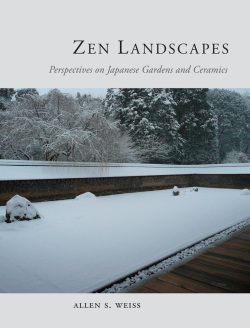

Karesansui and the “ineluctable and illuminative thread”

KYOTO JOURNAL 82 REVIEW BY Lauren W Deutsch
9781780231907
“To begin with a chawan in the palm of one’s hand and end up imagining a garden, poem or painting reveals the richness inherent in Japanese culture.”
— Allen S. Weiss
When I began to study chado, the Japanese “way” of tea, this left-handed, Jewish American woman wondered whether there was a hidden agenda or symbolic meaning in the movements of the utensils from point a to point b … to point n. Since the ritualized presentation of chanoyu—literally preparing hot water for tea — flourished during the Momoyama period when the daimyos were waging war with each other, I mused: Perhaps the mizusashi (fresh water container) and kama, (kettle) stood for the castles of feudal lords, and the many codified arrangements of other utensils referred to battle strategies, much like the Xs and Os of a football coach outlining a play. Or maybe connecting the utensils’ footprints on the tatami mat in a particular order revealed a secret kanji code. It’s not far fetched; supposedly the siting of Japan’s colonial headquarters in relationship to city gates and palaces branded the map of Seoul with thekanji for “Dai Nippon,” Big Japan, which surely would have been thought to affect the geomancy. However, I was wrong in all cases. It didn’t make “sense” in Western terms, yet, I learned, there is great “sense” to be made out of all of it.
Over time as a student of a master teacher, the inherent integrity of the practice of this most Japanese of Japanese cultural complexes began to reveal itself in many more ways than just making a proper bowl of matcha, Japanese powered green tea leaf. The rigors of the lesson began to creep out of the tearoom and into the larger sphere of every day life. My senses began to incline toward jaku, (tranquility), born of harmony, purity and respect—wakei and sei in Japanese. Without the benefit of any capacity to read Japanese, I loosely defined the term temae, the procedure for ritualized making of tea for the guest, as to just undertake the matter at / in front of (mae) one’s hand (te). It seemed that I had inadvertently bumped into the refined “metaphoric and synaesthetic imperative” that forms the foundation of Japanese “aesthetics, ethics and epistemology”, to quote Allen S. Weiss, author of Zen Landscapes: Japanese Gardens and Ceramics.
Thus, it was with great pleasure that I had the opportunity to read Professor Weiss’ exciting new book, one that is just as much a significant contribution to the growing English-language library of volumes about the influence of Zen-steeped chado on the Japanese mindscape as it is about the creations of ceramic objects and fertile, well-cultivated verdant spaces—i.e. the “land”scapes promised in the title. He, too, experienced bewilderment about the “sense” made by Japanese aesthetics until further immersion.
The reason Weiss wrote this book is that, upon finally visiting Kyoto’s 15th-century Ryoanji karesansui – literally dry /mountain / water dry stone garden, he felt that everything he had read about it paled profoundly in comparison to being there. In fact, Weiss, an acknowledged expert in the gardens of Versailles, reframed his assumptions about landscape in general. “I immediately suspected that my disorientation went far beyond mere culture shock,” he shares. The more he explored other areas of Japanese culture the more he realized that such gardens and other art forms—especially tea ceremony, ceramics and kaiseki cuisine—were connected by an “ineluctable and illuminative thread,” Zen Buddhism and thus become a holistic cultural experience that is greater than the sum of the parts.
Early in his text he offers a thorough discussion of the often cited but too-often misunderstood aesthetic qualities of wabisabi and shibui, attributes popularized through the spread and institutionalization of chanoyu that now crop up in other art forms. “Both aesthetics and connoisseurship in Japan are informed by these complex existential and conceptual matrices,” he comments.
Weiss explores both the performative and material nature of chanoyu that enables the reader to understand the point of the ritualized experience: to heighten the senses of the guest that will serve her long after she leaves the chashitsu, the rustic hut-like tea room. The guest not only takes full advantage of the host’s hospitality, she literally imbibes those ubiquitous Japanese sensibilities. Further, by drinking matcha from the roughly fashioned hand-made ceramic vessel, the guest is also in communion with the potter who crafted it. Likewise, Nobel Prize winning author Kawabata Yasunari weaves his storyThousand Cranes around a white Shino chawan, by giving it significance and utility far beyond its being used as a vessel for holding a beverage.
Discussing the nexus of Japanese aesthetics on the material plane, Weiss notes Japan’s ceramic and garden arts owe their substance to the “macrocosmic five elements of the Japanese Shinto / Chinese Taoist cosmos”: fire, wood, earth, metal, water. An entire cosmos may be perceived in the colors and textures of a patch of glaze on a chawan, tea bowl or a weathered wall surrounding a garden. This illustrates the first of nine maxims of his “Manifesto for the Future of Landscape”. (See sidebar.) Even further, he observes, “… the cosmos can be compressed into the form of a small garden, the garden reduced to the disposition of food on a plate, and the plated “landscape” represented by the patterns on the plate or guinomi (ceramic sake cup).” His divertisement about kaiseki cuisine adds another hint about his diverse and extensive aesthetic range.
As a grain of sand might be compared to a rock, for his discussion on ceramics, Weiss focuses on the guinomi, a proportionately identical but miniature version of the chawan. (Similarly, the 1 : 2 ratio of dimensions of a tatami mat may be found expanded and reduced throughout Japan, from a folded kimono to an entire building.)
To this end, his choice of highlighting the guinomi enables him to cite the huge diversity of effects produced from the past to today by Japan’s 100 major and over 50,000 minor kilns without being subject to the rigors of the strict chanoyu system. Weiss explores evolution of ceramics in Japan with ample examples from the venerable functional work of the Raku clan over the past 15 generations to non-functional creations by independent contemporary ceramic artists who incorporate mass production, “damaged” and found objects. He discusses how the variety of fuel used in the kilns and other site-specific characteristics and can import a “clay flavor” to a cup. Through his examples, one can see how collaboration of human and elemental nature that create “pottery landscapes,” including superficial traces of minerals and cracks that give a work its character, is also evident in the earthen walls, plantings and stone settings of Japanese gardens.
While a pebble is not a rock, nonetheless Weiss allows that “Representation implies both abstraction and metaphorization, such that—just as the qualities of each morsel on a plate are enriched by the adjacent foodstuffs—the profundity of metaphor depends on both the specific beauty of each of the terms and the vast range of qualities that simultaneously link and separate them.”
Throughout the text, Weiss sets up scenarios, ‘scapes, that unfold in Japan’s refined, concentrated garden spaces that nonetheless expand in the mind, no matter how large or small they may be, whether one strolls through, dangles feet from a verandah or sits on one’s heels on tatami mats. Each of the three basic styles of Japanese gardens—dry, stroll and borrowed scenery—depends upon the serendipity that comes from working with natural materials and on “a powerful sense of enclosure and threshold,” to quote Andrew Todd.i
While seemingly frozen in time, the karesansui gardens in fact have constantly evolved not only throughout history and as a result of the impact of the weather and other natural forces on the garden elements, but also are constantly changing as a result of the viewer’s vantage, including the disposition of the mind and the position of the body. In terms ofchanoyu, the phrase is ichi go, ichi e. This one moment can never happen again.
Weiss, a scholar, author and producer of numerous performing art forms and film, serves up provocative ideas and stimulating questions about what “happens” in these “empty” spaces. The eminent theatre director Peter Brook, provides a hint: “The stage is a place where the invisible can appear….”ii The role of the visitor to Ryoanji or any venerable Japanese garden is more likely that of a participant in theatre, neither uniquely audience member nor actor. The typical visitor to Ryoanji sits on the wooden veranda of the head priest’s quarters and, too often, begins by engaging the view of the garden from the mundane mind/body: counting the nameless rocks that jut above / nestle within the field of raked pebbles. While it is said that not all 15 rocks can be captured in a single visual frame, Weiss notes the one vantage from where this can in fact happen. (I relied on Google Earth: 35° 2’3.90″N, 135°43’5.50″E!)
The hidden presence of objects in spatial context is also found in other aspects of Japanese culture. “The extraordinary discretion of Japanese connoisseurship demands that very few objects be visible at a given time, and that an important work of pottery will be seen but rarely,” Weiss notes and references Junichiro Tanizaki, author of the seminal essay In Praise of Shadows.
But as tempting as it is for the average visitor to “waste” precious time counting rocks, or musing on how the gardeners leave no footprints while raking the pebble patterns, the participant might take the opportunity to find herself incorporated into the patterns as they “flow” around rocks, and are confined by the surrounding walls. The totality of the scene requires the witness to complete the scenario, adding the “missing” piece of the puzzle from her very being. Yoshi Oida, a long-time member of Brook’s theatre group has a helpful question for the garden visitor: “The space asks the actor, ‘Who are you?’ It asks this directly to the being, the personality of the actor.”iii
Weiss also generously posits engaging queries such as, if one of the rocks split, would that increase their number? He recalls the story about how the American music composerJohn Cage used the image of the placement of Ryoanji’s rocks as notes for a musical composition by the same name. Unlike gardens with extensive greenery, Weiss propose that the stones neither grow nor die; this is the “job” of the moss. Other changes of the garden are products of the seasons, such as snowfall, the growth of opportunistic foliage such as moss, or a leaf dropping into the midst. And, if no one is there to witness that leaf falling …
Perhaps the ultimate abstraction of a Japanese garden is the Noh stage. Constructed of natural timber the stage includes four posts, reminiscent of trees, with a kagami-ita, backboard, upon which is painted an oi-matsu, pine tree. In this rarefied “garden” kami(Shinto gods / spirits) come and go, interact with each other, and remind the audience of their ubiquitous presence in the theatre in every day life.
“I am convinced that especially in Japan all of the arts share a common aesthetic basis,” Weiss noted in recent correspondence with me. Through his guidance, it is possible to imagine seeing the mountain in the distance from the edge of a chawan, or from a distance cupping ones hands around the tsukubai, stone water basin emblematic of roji(teahouse gardens). I am convinced that this book, too, is a garden, a theatre, and a vessel in which one may fully explore the integrity and vitality of that which we call Japanese culture that we are lucky enough to experience.
Footnotes:
i Andrew Todd and Jean-Guy Lecat, The Open Circle: Peter Brook’s Theatre Environments. (New York, Palgrave
Macmillan, 2003)
ii Peter Brook, The Empty Space (New York, Simon and Schuster, 1968)
iii Todd, Lecat, op. cit.