Showing posts with label Kyoto Journal. Show all posts

Friday, September 20, 2019

Tea Huts 'R' Us?

As a 34 year practitioner of the Japanese tea "ceremony" chanoyu, literally tea’s hot water, I naturally gravitate to opportunities to see how contemporary artists try to replicate the architectural features that foster a unique ambiance in which a host and guest sit together to share a bowl of matcha. 

Thus, I was thus intrigued by the recent installation of Mineo Mizuno’s HARMONY on the lawn outside on SWP next to Resnick Pavilion. It reminded me of the nursery rhyme finger game "here is the church, here is the steeple ..." It seems to project an ambience without literally being a useful space!

In fact, typically one doesn't see any of the occupants of a tea hut. I intimacy is the cornerstone of hospitality of a tea gathering. 

Like most “classic” tearooms, it’s about 9’ x 9’, accommodating a maximum of 5 guests and one host. His interpretation includes a nijiriguchi, wriggling in entrance, that requires the guest to stoop and slide inside on knees, and a tokohoma, raised alcove for a hanging scroll and/or flower arrangement. It has wabi and sabi sentimentality of simplicity and rusticity. Inasmuch as the entire structure is constructed in branches of local wood, having a special tokobashira, the usually unfinished wood pillar at one side of the alcove, is redundant. This important structure punctuates the otherwise sparse interior with a sense of nature. Can you imagine sitting on the floor, much like a spot in the virgin woods?

He brings in the harmony, purity, respect and tranquility that is at the core of the mindfulness practice by the use of kanji characters of wa written on the outside of the tea bowl nested inside the wood stump to the left of the hut. Another bowl, to the right, has the characters for mizu, water, written on its surface. This could stand for the tsukubai, fresh water basin, that is always present in a roji, the garden in which a tea hut is situated. The guest will walk through the small garden en route to the tea hut as a liminal journey, a path of purification to leave all mundane cares and concerns outside.

Just for fun, I'm showing a comparison of Mizuno's nijiriguchi (center) with guests entering Shogetsuan at Hakone Gardens in Saratoga CA, (left), and Tom Sachs' (pictured, right) seen as host through his guest entrance at his installation at the Isamu Noguchi Museum (2016). 


A chaji, informal tea gathering, can be held just about anywhere one can whisk matcha in hot water and enjoy the company of friends.

Below (left) is the Water Pavilion created for the 1st Los Angeles (City) Public Art Triennial (2016 in Balboa Park) by Rirkrit Tiravanija, for which I produced a weekend of tea demonstrations celebrating the LA River. Right is a photo of my making tea for Eric Lloyd Wright and Mary Wright atop their yet-unfinished home in Malibu overlooking the ocean. (I used the rebars to contain the space.) 


For more information on contemporary interpretations of the chashitsu, I recommend Japanese Designers and Tea Houses

Lauren "Sochi" Deutsch has been a LACMA school docent since 2014. She is a licensed instructor of the Urasenke Tradition of Chanoyu and has done many tea demonstrations at schools, colleges and public events. She studied under the late Matsumoto Sosei, sensei beginning in 1985, and also was a guest in Kyoto at the Midorikai program. Lauren is a long-time contributing editor and board member of Kyoto Journal. Professionally, she currently is a free lance grant writer mostly in the arts and environmental issues. In addition to volunteering at LACMA, she is on the Community Advisory Board of Public Media Group of Southern California/KCET and deckhand-in-training for Los Angeles Maritime Institute. More info @ www.pacificrimarts.org. (All photos from the author.)
.


Tuesday, May 19, 2015

Review: The Korean Way of Tea: An Introductory Guide

The Korean Way of Tea: An Introductory Guide

by Brother Anthony of Taizé and Hong Kyeong-Hee
(2007. Univeresity of Hawai'i Press. Honolulu.)


Reviewed by Lauren W. Deutsch 
KYOTO JOURNAL 71

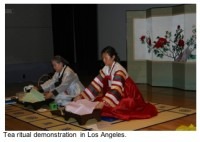
LAtea“Too fussy,” observed a member of the audience watching the formal presentation of the “Korean Tea Ceremony” at the consulate’s culture center in Los Angeles. The demonstration by members of the local Korean tea culture group was consciously but gracefully paced and helpfully narrated by a young woman dressed in hanbok, traditional jacket and skirt. A grass mat was spread in front of a display of a “woman’s room” of a literati class family, a landscape painted screen stood to one side and gayagum music filled the air. Having studied chanoyu, Japanese tea ceremony, for 25 years, I can attest that the preparation effort seemed anything but “fussy”. In fact, it looked particularly natural in its economical movements and resulted in a few sips of yellowish liquid that tasted warm and soft on the palate. Not fussy at all.
masterKorea has had a “Way” of tea but it hasn’t been widely seen, much less described or studied by foreigners. This new guidebook full of color illustrations, created by Brother Anthony and Hong Kyeong-Hee and published by Seoul Selection (available online), is a welcome edition to one’s tea or Korean culture library.
The book is a labor of love produced by two simple, cultured gentlemen whose relationship has been refreshed again and again over cups of tea. Having enjoyed tea with them in Mr. Hong’s Anguk-dong residence, I could imagine these two literati having met centuries ago, the former a renowned translator of Korean poetry and literature into English and the latter an unassuming scholar / teacher of letters.
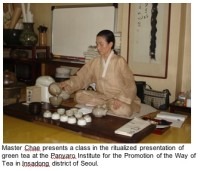
prepBeautifully illustrated and filled with poetry, history, science and anecdotal material, the book itself feels like the un-fussy nature that one associates today with enjoying a cup of carefully prepared Camelia Sinensis, seated on a floor pillow or low stool in one of the many tiny, rustic tea rooms crammed one upon and next to another in Seoul’s Insadong antique district.
The contents of the book constitute a refined and expanded text developed from the “blog” presented by Brother Anthony on his website. The site contains an index, links to his articles in the Korea Times and other tea sites.) A “congratulatory” message from tea master Chae Won-Hwa, founder and head of the Panyaro Institute for the Promotion of the Korean Way of Tea, certifies the authenticity of sentiment and literal meaning of their words.
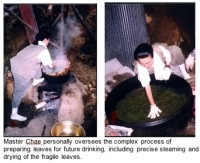
altarDuring Korea’s 19th – 20th century Colonial Period, the Japanese were happy to lay claim to Korea’s tea resources as they did the potters who were taken back to Japan to support their burgeoning Japanese tea culture in the 16th century. While some Koreans pride their culture as lacking the “fuss” usually associated with Japanese arts, this does not mean it lacks form or focus. From the growing of tea leaves and their processing for packing, to the preparation of self and leaf into beverage, Zen Buddhist philosophy – Seon Cha – as well as the courtly arts may be infused in every leaf and gesture.
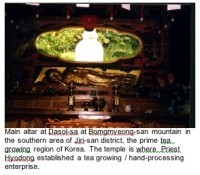
Panyaro (“’Dew of Enlightening Wisdom”) green tea is meticulously grown on and hand-processed at a plantation near Bomgmyeong-san mountain in the southern area of Jiri-san. Chae Won-Hwa has formalized a rltual for preparation also, interpreting the manner taught to by her teacher, the Venerable Hyodang, head monk of Dasol-sa temple near Jinju. This temple is still a source of fine hand-made tea, and wild tea plants may be found along the mountain slopes.
Tea, like Korean cuisine in general, was also enjoyed in a courtly manner by ladies and gentlemen who attended the royalty, so naturally, there were appropriate embellishments, such as in the utensils and manner of offering the beverage to their Esteemed Majesties. Such external “fuss” may have been implied in the Los Angeles demonstration critique but the preparatory manner was clearly well-intentioned.
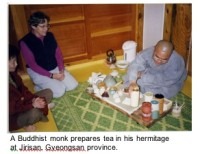
I have enjoyed very informal tea with Buddhist monks in Korea. A cloth-covered tray with small cups lined up next to a stack of small wooden coasters, a horizontal handled tea brewing pot, two lipped bowls for cooling, a source of hot water and a box of tea and good will is all that is necessary. We joked and he poured. Laugh. Pour.
It has taken Korean over 50 years to reconstruct and appreciate its own unique Way of Tea. The vast majority of Koreans would rather drink small paper cups of instant coffee prepared with creamer and lots of sugar and to sit at Starbucks or a French pastry cafe. Now, through the efforts of such men and women of tea, Korea’s cultural traditions are finding their way to a renaissance and broad interpretation.
While we’re waiting, we can enjoy a cup of tea. Hold the “fuss”.
 
monktea
Photographs: Lauren W. Deutsch
Copyright held by the author
(better images will be uploaded soon)

Opera Review: Tan Dun's "Tea: A Mirror on the Soul" from Kyoto Journal 71


Review: Wabi Savvy: When Less is, More or Less, More


Review by Lauren W. Deutsch
KYOTO JOURNAL 29

Wabi-Sabi for Artists, Designers, Poets & Philosophers
by Leonard Koren (1994. Stone Bridge Press. Berkeley CA)

Should you not be one of the types listed Leonard Koren's irresistibly titled 96-page murder-mystery-who-done-it lamentation in two acts and wish to venture forward, fear not; for wabi-sabi is as close as the classic pair of blue jeans you have hanging in your closet.  According to author, this "most conspicuous and characteristic feature of what we think of as traditional Japanese beauty," is an endangered species, taking its most direct hits from the very forces which nurtured it: the Japanese tea ceremony establishment. 

Trained as an architect and creator of one of the premiere avant garde magazines of the 1970s WET: The Magazine of Gourmet Bathing, as well as such books as 283 Useful Ideas from Japan, how to rake leaves, how to take a Japanese bath, and others, Tokyo / San Francisco resident Koren self-inflicted the challenge to wrestle in writing the most slippery of ethereal-material notions.  His goal is to thrust it into "a meaningful system", "'saving'", he says, "what once constituted a comprehensive and clearly recognizable aesthetic universe."  In a sense he asks whether the experts at saving face can save their aesthetic soul.  

Definitions are in order.  Koren loosely appoints the word "rustic" as the meaning of the confederation of two quite distinct concepts.  Classically, wabi, refers to the "misery of living alone in nature, away from society" in a "dispirited, cheerless emotional state," and sabi, "withered" or "lean."  The wabi-sabi compound is contemporary, a lackadaisical slur suffered from years of misuse, and, as Koren intimates throughout the book, clandestine abuse. 

A wise mortal nevertheless, Koren honestly pursues a dialogue.  No doubt with the popularity of this black-white "sabi-esque" photograph-illustrated book, he will get his wish.  Not willing to defend spiritual materialism on any front, this reviewer wishes to ask: Why should  anyone hold on to anything in this universe ... whether it is our breath or our ideals, much less / much more how could  anyone "save" that which by its very nature must disintegrate.  Whether we are philosophers or philosopher-plumbers, the least we can do is to be sensitive to the wabi-sabi seasons all around us.  On the way, in concert with Koren, we face many pitfalls. 

The high priest of wabi-sabi was, of course, Sen no Rikyu (1522-1591), chajin-for-all-seasons.  While not the first man of high rank to discover beauty in something simply, commonly fabricated, new or old, Rikyu and his progeny -- a carefully accounted for 400 year lineage of 15 generations of oiemoto  (grand masters) set wabi-sabi standards to be appreciated and valued through Chado, the Way of Tea.  And, as Koren more than once mentions, Rikyu's heirs have carefully honed and refined this into a capital concern of great magnitude.  Throughout the book, though a bit helterly-skelterly, Koren indicts the imperial-like patriarchal system for its presumptuous hold on what's right and what's wrong.  Who's asking?

Politics aside, the book does provoke the mind, making one wonder what's the fuss all about anyhow.  Is there really a difference between a pair of blue jeans well-worn in "real time" and that stone-washed "look" created by fast-forwarding the fabric through a chemical process?  Do the pants create the woman or man or vice versa?  And who cares?  This is fun.

Many years ago during a camping trip in the Smoky Mountains, I attended a Saturday night town social in Galax, Virginia attended by probably everyone -- old and young -- who could get up the fire house stairs to the community hall.  My city-slicker partner and I put on our clean(est) blue jeans and prepared to blend in with the natives for some down-home bluegrass music and dancing.  But we were the only ones in blue denim; everyone else turned their work clothes in for fancier duds.  Not even a pair of "designer denims" were to be found anywhere.  Being "correct" is very complicated.

Koren's "unswerving principles of wabi-sabi " are illustrated here: #1/ "No one object or element ... shall stand out above any other."(We tried to blend in.)  #2/ "Thou shalt not revere the old for old's sake."  (If the pants fit, wear them.)  I wish the book would consider other principles (the author's), such as: #3/ Some things build up over time like young mountains; others, like old ones, wear down; (Patch holes over the knees were once the rage -- quite practical, actually -- now it's the holes themselves which are sported with savoir faire.)   #4/ How to detect wabi-sabi fraud?  (The pants cost more than a day's wages and have been dry cleaned.); #5/Wabi-sabiness is not transferable from symbol to significant nor vice versa.  (Beware of tourists!)

Pablo Picasso once reflected, "I want to live like a poor man with a lot of money."  Poverty has never been as chic as it has emerged in the 20th Century USA and Western Europe.  Take the current "home boy" gang-inspired fashion, the city rapper fatigues ... baseball cap perched brim backward, huge, funky pants (how do they keep them up?), layers of flannel shorts atop a hooded sweatshirt?  Mucho dinero  from Japan to Paris ... soo cool even in the "I hated the riots, didn't  you?" Westside of L.A. 

As for the notion of refined rusticity, that "further retired" feeling, an L.A. art critic once noticed how artists are the real estate tycoon's bloodhounds in the property speculation hunt.  Once artists move into what is usually the dangerous, depressed (read "cheap rent") parts of town, these areas become trendy and rents quickly inflated, driving the artists further and further into more dangerous, depressed ... etc.

Poverty is not inherently chic and, it's very expensive.  Most homeless people of sound mind* would like to get out of the cold.  What they would do with Picasso's wealth is certainly another story.  Given the preference of a classic structure from L.A. architect Frank Gehry (walls made from inexpensive corrugated metal, cinder block and adobe with chain link trimming) or something which resembles Versailles or Katsura, who knows what would be #1.  (Don't mention which would be more cost-effective for a government to build.)  We're not talking about urban camping which could a delightful social experience on a hot night.

In short, becoming vulnerable is an essential humbling, human experience.  It shows we are living.  Perhaps it is a dulling of our sense of responsibility for our actions individually and collectively, in the name of science and art, about which Koren is sounding the alarm.  I hope he writes a sequel for people like me.  (Disclosure: I worked for Koren at WET in the late 1970s).


* There are reports of homeless people living on the streets in L.A. who have been identified by social service agencies as preferring not to  be tied to a regular form of shelter, even if they could afford it.  In New York, there have been legal battles about whether someone by law must go to a shelter if offered.)

Reviews: "The Tea Ceremony and Women’s Empowerment in Modern Japan" and "Japanese Tea Culture: Art, History and Practice"


Reviews by LAUREN W. DEUTSCH
KYOTO JOURNAL 71


The Tea Ceremony and Women’s Empowerment in Modern Japan: Bodies Re-presenting the Past
by Etsuko Kato
(2004, Routledge Curzon, New York)

Japanese Tea Culture: Art, History and Practice
Morgan Pitelka, ed.
(2001, Routledge Curzon, New York)


Coffee–table books about tea tend to offer pristine views of paradise and bowls of world peace. Page after page of steamy shadows and shadowy steam, dewy landscapes fashioned by gods with impeccable taste, a solitary red maple leaf or cherry blossom petal captured mid-fall, fresh green tea froth (or sludge, depending upon your “school”) glaring up through ceramic ensos like the third eye of the Wizard of Oz. Enough!
For a breath of fresh wind in the pines, two books from the scholastic press of Routledge Curzon are recommended for those with a serious inquiry into the world and way, practice and place of the tea ritual in Japanese culture: The Tea Ceremony and Women’s Empowerment in Modern Japan: Bodies Re-presenting the Past, a dissertation by Etsuko Kato, and Japanese Tea Culture: Art, History and Practice, a collection of sometimes quirky but scholarly essays edited by Morgan Pitelka.
“We participate in a tradition of commentary and critique that extends back to the sixteenth century … In writing, we participate in the ongoing cultural production of tea,” states editor Morgan Pitelka, editor of the first book mentioned. One thing for sure is that the do (way) of cha, like the yu (hot water) for cha, is not a catalyst strictly speaking. It has changed in the process of changing culture.
Kato’s book illuminated and clarified many of my own observations as a practitioner of chanoyu for 24 years, mostly in the company of Nisei, Sansei and recent Ise expats living in Southern California. She presents a thoughtful critique from behind-the-scenes of the growth and development of chanoyu as enterprise for women in particular.
On the other hand, Pitelka, a professor of Japanese culture with an expertise in ceramics for tea practice, is the “outsider.” His contributors look at tea through a diverse set of filters, from social and art historians, current and former functionaries of tea schools, museum curators and an academic anthropologist. He promises that “This book is in no way representative of a new school or movement of tea scholarship.” Neither is it another gospel patronized by or in homage to the current chanoyu “establishment”.
Each book has a section that addresses the sanctification of Sen no Rikyu, chanoyu’s great tea ancestor and in whose name we study and practice the craft / art. The fact of Rikyu’s imprint on tea since the mid 16th Century, and through him, the likes of scholar-priest Eisai, Murata Shuko Takeno Joo, Kobori Enshu and his contemporary Furuta Oribe and progeny are admired, is not in question, but his “word” has become legendary and subject to commentary, much like what Talmud is to Torah.
In Pitelka’s book the essay “Rikyu Has Left the Tea Room”, tackles Rikyu’s star-power through analysis of three modern biographical films. Kato, on the other hand, looks at the commodification of the Rikyu mythology and the bloodline of the iemoto system (hereditary lineages producing quasi-monopolistic authorities).
If we were to take Rikyu literally, we would we only need to acquire tea, carry water, chop wood, make a fire, boil water and knead the mixture. By alchemical extension, we would convert history into tradition, tradition into spirituality, spiritually into social propriety, social propriety into intellectual expose.
Both books also discuss in detail how chanoyu’s economic, social and cultural “capital” have developed and been manipulated to suit the needs the tea establishment. Tea as enterprise impacted clusters of complementary professionals (e.g. ceramic craftspeople and merchants) who were able to make a living sharing the practice, even if only limitedly, to a willing and impressionable populace.
If there was such a cultural complex as chanoyu a half century ago in the USA, it would have been studied as home economics. To elevate it to the status it enjoys in Japan would require patronage by someone as pop culturally powerful as Martha Stewart or Oprah Winfrey. This is clear from Kato’s feminist approach. For example she takes us to a Japanese department store “art” gallery exhibition entitled “Saint Rikyu”. More than just “big box” stores of today, in Japan they are to women in the tea world the equivalent of men’s social clubs: natural, “safe” places that present chanoyu as “high” art and socially acceptable places for women to gather in public outside the home and tea room. I was told by a tea informant that Japanese women were more liable to travel independently of their husbands and with their female friends to national or international destinations following their grand master teachers around in the name of tea. The delegations of dozens of middle age women chajins who have visited Los Angeles over the years is proof.
A significant portion of her writing covers the practice of temae, the set of choreographed movements comprising the modular elements of the longer, more “formal” chaji tea gathering. The “birth of tea as “sogo-bunka” discourse, the “cultural synthesis” or compendium of every traditional Japanese cultural “art” form has important implications. She also distinguishes tea benkyo (study) of tea as geijutsu (artistic form) fromsaho(“etiquette or good manners with emphasis on mind”). Given the emphasis on “bodies” in the subtitle, I did expect a deeper discussion by Kato about body image and the physicality of practice. She does mention wearing of kimono but doesn’t mention anything about the painful practice of sitting seiza.
Both Pitelka and Kato utilize chanoyu as a portal, rather than as metaphor for further social and cultural studies. She takes the tack of feminist theory and looks at the lives of women in the post-Pacific War period, their achievements in higher education, marriage-ability, vocation / avocations, etc. Chanoyu practice is regarded with high status among all cultural elites in Japan, and a woman’s top rank could even place her in some circles above her corporate executive husband.
One of Pitelka’s authors presents how 20th Century excavations on Sanjo-dori in Kyoto at known sites of ceramics merchants’ shops are revealing how Momoyama folks shopped for “pots for tea”, what types and styles of goods were sold during that period.
Pitelka’s own writing examine the Edosenke school’s “warrior tea”, prominent in the late Tokugawa period, and the often-marginalized Sen Koshin Sosa, the founder of Omotesenke tea school. Another of his contributors offers insight into the early karamono (Chinese objects) utensils as they made the transition from use in sencha (leaf tea) ceremonies to matcha (powdered tea). Two other essays explore how chanoyu utensils were valued by warlords’ as battle spoils. In some ways chanoyu seems a bit like a Mata Hari, something that could stop the boys in their tracks and make them find true happiness.
I have always wondered whether there was any tea practice among Japanese-Americans relegated to remote concentration camps and the chado studies of my own sensei who spent that period in Japan at the home of the XIV Urasenke grandmaster. I cannot imagine that making tea was as forbidden as was the practice kyudo or kendo, Zen archery and sword, respectively for two reasons. First, neither tea ladle nor scoop could be mistaken for a weapon; although they are handled with those in mind. Secondly, no one would consider a female master chajin’s making a bowl of tea a threat to national security.

JAPAN GOES MOD(ERN)


JAPAN GOES MOD(ERN)

3 REVIEWS BY LAUREN W. DEUTSCH
KYOTO JOURNAL 58

Turning Point: Oribe and the Arts of Sixteenth-Century Japan
Miyeko Murase, ed. (Yale University Press, New Haven, 2003)

 Mavo: Japanese Artists and The Avant-Garde 1905-1931 
Gennifer Weisenfeld (University of California Press, Berkeley, 2002)

Mirror of Modernity: Invented Traditions of Modern Japan
Stephen Vlastos, Ed. (University of California Press, Berkeley, 1998)

Imagine … It's early 1924. Furuta Oribe XII's 20-something only son, Oribe xiii, is deep into an early mid-life crisis. Life as an heir-apparent is not cutting it. Endlessly attending and holding those stuffy tea gatherings every time a cherry blossom petal takes to wind or a maple leaf blushes. He's full-up-to-here with the pretentiousness of emptiness, with a capital "EMPTY". Besides, no one sits seiza anymore.

His family's legacy of quirky ceramics and interior design, so beloved by generations of aesthetes of yore, has not transitioned into the new social economy. The Western hungry ghosts have insatiable appetites for Japanese oldies-but-goodies Chinoiserie knock-offs. The nouveau riche industrialists are good to go 24/7 with assembly line versions of his great-great-great-etc. granddaddy's classics, but the output is so much vulgar stuttering, diluting the genius of spontaneity. They think a whack of a paddle, a swish of brown slip and a splat of green glaze and … a masterpiece. Ha!

Very soon he'll be installed with full rights as Mr. XIII. This will mean managing and supporting the dreary household staff. It's not his cup of tea.

Wriggling out of the nijiriguchi, he hangs up the "Sorry We Missed You!" sign on the roji gate and heads for the sento. In the genkan, the front page of the morning's shinbun blasts an editorial about the decline of morals of youth due to a dangerous and growing sense of individualism among the intelligentsia. Women are cutting their hair short, exposing their skin in public, and men are wearing unisex fashion. There's a notice about a group of artists who are staging an art show and poetry reading at a café in support of a petition for more affordable housing. Another about the round up of students hanging out at that same joint.

Slipping into his new brown hounds-tooth jodhpur, cream mohair jacket and forest green leather boots, he heads shitamachi to find that little café. His soul is dry. And he's very thirsty. Thirsty for a fresh look at the world.

Consider what might transpire if xiii had met the modernists of his own time, Picasso for sure … But this fantasy must serve this review, so he meets Murayama Tomoyoshi and his band of merry Taisho pranksters, the artists of the Mavo movement.

Turning Point is the long awaited book on about the impact of Momoyama generalissimo chajin Furuta Oribe on Japanese aesthetics. Hideaki Furukawa, the director of The Museum of Fine Arts in Gifu, offers in its early pages, "The impulse to challenge and defy convention could be called the defining theme of Japan's Momoyama period. 'Oribe' neatly captures this sprit of creative nonconformity…" The Oribe book made its debut in sync with the block-buster one-stop exhibition of the same name held at New York's Metropolitan Museum of Art staged at the end of 2003 through early 2004.

Weisenfeld's dense opus, Mavo,  is a chronicle of the activities, inspirations and impact of Mavo, the Japanese sociopolitical aesthetic movement dated 1905 - 1931. It primarily focuses on Murayama Tomoyoshi, the movement's mastermind, who seemed to have a whole lot of fun stirring up the already turbulent Taisho status quo, with a capital QUO. While a bit dense to casually, the narrative would serve very well if complementing an exhibition.

"Mavo was a self-proclaimed avant-garde constellation of artists and writers collaborating in a dynamic and rebellious movement that not only shook up the art establishment, but also made an indelible imprint on the art criticism of the period," she outlines.

Rigorous narratives supported by copious illustrations fill these two volumes. By re- and de-constructing reputations, myths and the physical remnants of the times, they address philosophy and production of art in a multitude of methods -- from clay and oil painting and sculpture, to architecture, theatre and the mass media. They also give us images of how Japan deals with errant aesthetes.

During each period, evolutions of artistic styles were inseparable from developments in Japanese enterprise, hegemony and industrialization, mass consumer culture, and social order. Bookending three centuries of isolationism, it may be argued that the volumes under consideration reflect "modernist" trends within its own time period, providing an interesting spectrum from which to explore the premise of Vlastos' book Mirror of Modernity: Invented Traditions of Modern Japan

"Artists are too often omitted from sociopolitical studies [of the Japanese intelligentsia], here they gain their rightful place in the debates of the early twentieth century. Including those who dealt with art: educators, bureaucrats, dealers, collectors and publishers," notes Weisenfeld.

As an exhibition catalog, Turning Point is a font of illustrations of stunning dogu for chanoyu. It also contains generous helpings of mind -candy about the who / how / huh of Oribe. In addition, it offers literary works, screen painting and even Portuguese maps and diaries. Each points to Oribe's impact as a major "player" in volatile and changing political, social and cultural landscapes of his time … and now.

A major focus of the book and exhibition is the new archeological scholarship being undertaken at historic Seto kiln sites. Sifting through household waste and layers of potsherds, they are documenting the popularity and mass production of Oribe-ness. What is lacking in both book and exhibition is a sampling of today's Oribe-ish ephemera such as plastic sushi bar shoyu dishes. Do I ask too much?

The editor states, "During the era of Oribe, a common aesthetic language bound all the visual arts more strongly than any other time in Japan before or since, and intimate working relationships existed among artists in different media." Until the advent of Mavo, perhaps.

Like the French impressionists in the late 19th century, Murayama and his avant-garde cronies took on the gadan (art establishment) of their time, unabashedly challenging conventional taste and social norms. And like Oribe, Murayama was charismatic and drew tremendous inspiration from his collaborations with others.

Where Oribe's jazzy naturalistic designs were to be "seen" mostly dimly lit tea rooms set to promote harmony and tranquilly, purity and respect, MaVo was a brash, in-your-face under- and-above-ground collective tour de force affront to the bitter reality of life Meiji / Taisho.

The origin and significance of the "Mavo" name itself  seems to be contested among the group members. The most widely disseminated story has it coming from a random selection within a collective process with representation of the membershipitself. While a hotly disputed conclusion, it proved to be a useful "brand", replete with mystery. The actual composition of "membership" also waxes and wanes with opinions, however scholarly, but consensus contends it fluctuated.

What is quite clear, however, is that they played turned everything upside down and backwards.. For example, The "V" in Mavo on their publication covers is mimicked in several of the members' (men and women) hair styles … or is it vice versa? Like Andy Warhol's "Factory" in New York of the 1960s, the group of young, largely self-trained Mavo men and women spent as much energy promoting its manifesto as making the "art" itself.

"While drawn together because of a 'constructivist inclination,'" states the author, "the Mavo artists did not assert ideological solidarity. Rather, they maintained distinct convictions, respecting each other's personal goals."
On the serious art side, Mavo was deeply imprinted by German Abstract Expressionism and the "happenings" of Dada and other modernist movements in Europe and the USA. Illustrations include architectural designs catering to the lifestyle of the proletariat. Graphic designs for leftist literary works, periodicals and promotional materials for Mavo events incorporated typographic influences of Europe (including classic Germanic script and Hebrew!).

Weisenfeld writes:  "They strived to revolutionize the form, function and intent of Japanese art. They aimed to reestablish a connection they felt had been broken in the Meiji period with the codification of autonomous "fine art' based on the Western model … reintegrating art into the social (and political) practice of everyday life."

As a friend living in Japan said, it would take an exhibition in New York or Paris for Furuta Oribe to be publicly claimed by the Japanese as a favorite son in "mixed" (gai and Nihon-jin) company. And then there's Mavo. Can't imagine the French keeping Picasso a secret for 400 years, much less declaring the uniqueness of analytical cubism.
  
If you're reading Kyoto Journal, you have undoubtedly been in this situation: You're in the market check-out line; your basket includes tofu. The Japanese customer in front of you turns and, eyeing the tofu, says, "You can eat?" You nod, perhaps a polite grunt, and say, "Do you eat this?" "Yes, but I am Japanese."
  
In Mirror of Modernity his excellent collection of essays on an eclectic assortment of "modernisms", Stephen Vlastos writes, "Modern Japan is widely regarded as a society saturated with customs, values and social relationships that organically link present generations of Japanese to past generations." (The accompanying article, "En Avant Garde" attempts to exercise this notion.)


A confession: I fell for it when I was a teenager. I believed in Japan's reverence for the traditional. I shunned rock 'n' roll for origami. I completely missed the party scene in the 60s and am trying to make up for lost time by getting high on matcha and eating dried breakfast cereal called "Zen".

An easy, entertaining read (with a great index, glossary and bibliography), the book takes us backstage to view the artifices of the Meiji and Taisho with compelling arguments to support his conclusion that there may be no there "there". It's done with mirrors.

Vlastos central question is, "How, by whom, under what circumstances, and to what social and political effect are certain practices and ideas formulated, institutionalized and propagated as tradition?"

While it is stated that Ito Hirobumi was the principal architect of Japan's modernization project in the latter part of the 19th Century, we are told that Yanagita Kunio invented the "tradition of Japanese tradition" by claiming, "Japan's preservation of its original culture made Japan unique among modern nations. Japan alone had achieved modernity without cutting itself off from its original culture."

"Every tradition trades between two poles: imagination and contrivance, creation and deception, he says."

The explosive growth of Japanese capitalism after World War I sparked new media technologies, new forms of entertainment and pleasure seeking, and the mass markets with their items of personal consumption. It's how the Daimyos became princes and evolved into CEOs.

Vlastos' selection of 16 essays by which to explore the social and cultural chaos is eclectic: the fundamental notion of wa, harmony, is hit head-on. Other checkpoints include labor management, shifting gender roles as reflected in the café waitress as moga (modern girl), the development of sentimentality for folksy village life, the challenges to tame colonial Manchuko with Imperial loyalty. At the same time the archipelago was evolving into a "modern" nation state, newly contrived prefectural identities were galvanized with neo-religious fervor.

One of the most intriguing discussions is the morphing of the classic warrior skills into more broadly accessible martial arts, budo, represented here by Kokudan judo. This provided a safe way to address the threat of the growing popularity of sports and the penultimate expression of world harmony, the Olympics  -- a Western construct which was considered dangerous to the populace as it could infect society with "individualism and liberalism". Author Inoue Shun notes, "Ideologues argued that sports must be "Japanized" through budo." These "games" became a much-needed "safe" expression of national identity and was consumable casually or otherwise by everyman.

Another intriguing piece deconstructs the notion of "home", the architecture of domestic life, in post-Meiji. Its author, Jordan Sands, notes one of the big jumps from the feudal to a modern, social construct could be found in the new practice of family dining. This meant synchronizing mealtimes and sharing an eating place. It required replacing individual meal trays with a dining table. He goes on to address other elements of domesticity such as interior design as it imposes and implies social status and carves out the possibility of privacy.

The author's own essay focuses on agrarianism. "At the end of the 1920s embattled farmers and rustic intellectuals transformed agrarianism into a movement of economic renewal and political activism. Farmers, desperately searching for practical solutions to the very real problem of economic survival, and rural polemicists, certain that capitalism and city culture were the root cause of the crisis, developed their own brand of agrarianism."  Capitalism's "erosion of social authority" was thwarted by "the enshrinement of the agricultural village as the well-spring of authentic Japanese culture."  As a result of the social turmoil of the 1930s, the reassuring image of harmonious and productive farm families served the ideological needs of many sectors of Japanese society, he concludes."

Vlastos calls upon to Miriam Silverberg for a glimpse of that new “traditional” phenomenon: the café waitress as representative of moga. Not to be confused with geisha and the kissaten, coffeehouse, staff, she was "bourgeois woman's challenge to established gender norms".

[The café was itself a modern construct. Unlike the coffeehouse, which is said to have been established in 1888 and could be considered a version of the pre-modern teahouse, the café, was considered a "modern success of the Taisho-period milk halls," the author says, but does not describe further. Puratan (Printemps) is considered the first Japanese café, modeled after the male-staffed French hangout. Puratan was opened in the spring of 1911 by the artist Matsuyama Shozo, a painter in the yoga (Western style) who served food and wine to go with the graffiti he had painted on the café walls. It catered mainly to the salaried middle class and intellectuals.]

Going back to the front of this article, it attempts to demonstrate how Japan draws upon the past to create and validate the present and uses this energy to illuminate the past. Sounds like a flawed plan for a perpetual motion machine. I maintain that one must go back as far as possible and cite the source. Rand Castile, the American scholar of chanoyu, once observed that Rikyu created wabi. Sabi, on the other hand, cannot be created. "Perhaps wabi exists only in opposition to something." I maintain this tension is similar for the notion of "modernity."

Taking Vlastos at his word, I can't help but look at the Momoyama's chado explosion, with its nostalgic bow to the artifice of wabi and chashitsu -as-cosmos construct. Are these any less contrived than the café and sumo's yokuzono system discussed in his book? Aren't the former "modern" for their time?

When asked why, despite the unbroken lineage and impeccability of presentation of the art, the oiemoto of a major chanoyu school is not designated a "living national treasure", I was told that no one can tell him he isn't.

I would suggest that this practice of self-alignment has something to do with encounters with gaijin. Perhaps it was an act of purification, much like the Biblical Exodus period of isolation and wandering in the desert to galvanize identity. While not discussed, it seems necessary to determine whether there was a lack of fabrication of tradition during the 300 years of Japan's isolation until "opening up".