"We'd love you to do a tea ceremony for us ... "
I recently agreed to do two off-site (i.e. not in a room with tatami) chanoyu demonstrations, each one requiring a lot of imagination to create the intimacy one associates with the post-card ambience: that quiet garden in a Kyoto temple where lovely ladies in gorgeous kimono quietly serve a bowl of tea to guests who are seated
seiza on tatami without the pain in their legs rushing up to their faces!
While I appreciate being asked and am more than happy to share what I have learned and enjoy about chado, I really have to stop for a moment and consider what it entails.
I will not take apart my chashitsu to schlep tatami on location; I don't own furniture, such as a misonodana; I don't believe that a simple
ryakubon or
chabako has the theatrical impact when presenting it to large groups.
Managing expectations, what a great magician can do, seems to be the most difficult aspect of complying with this request. If willing, a magician does the trick several times and then will slowly go through the motions and explain the ruse that her well-honed skills enable her to enact. It also requires the audience to
suspend disbelief.
I have in fact told my "audiences" that I am here to manage their expectations.
I have explained the order of the day: I go over what I am about to do; I will do it; and, finally,
nothing will happen.
What do you "want" to see? What do you think "will occur"?
Temae is a series of choreographed hand gestures that produces something
very, very ordinary. One doesn't need to learn the gestures to produce something that everyone can easily take for granted and basically does every day themselves.
For this reason I usually don't put on kimono; I wear a haori for dramatic effect and might remove it; I wear a black turtleneck and black meditation pants, and tabi. The closest my hairdo will come to a geisha wig might be if I wore Mickey Mouse ears with chopstix through them.
Presto!? I only wish that it was so Presto!
It always feels like car camping: I have to set up a makeshift
mizuya, often where there is no potable running water or electricity for the hotplate in the furo;
sumi is usually out of the question (no indoor fires, expensive and hard to get in the USA).
But I did them. One of the demonstrations -- with just a demo guest; no tea would be served to the audience -- was moved from a university classroom to an outdoor concrete patio (so that more people could watch and several budgets tapped for the honorarium). The other was in a museum classroom where 25+ audience members would be served tea as well as would the one guest.
In all cases I had one hour to do the presentation, including the set / clean up in the first case. The
kama didn't have time to cool down completely before I had to leave. There wasn't a place, except for the bathroom, to clean the bowls if serving tea to "real" guests.
I deeply appreciate my helpers in all cases. When I offered to my assistants the opportunity to not wear kimono, Nobie mentioned that it was the
mizuya-cho's responsibility to make the host look good.
I learned a lot from this statement. Thanks!
Gassho!
What is most remarkable, however, is that the
temae itself seems to draw people into a single mindedness, even if they are seated on chairs and the activity is on the floor. Folks mention it afterwards. I'm humbled.
It seems different when
chajin decide to do a
chakai in an "experimental" situation. I'll write more about this in a future post.
Post Script
A month later I received a call from an artist whose friends were putting together a tea house in Griffith Park, the city park, in a secret-sort-of place on a hiking trail.
They thought they wanted to have a tea ceremony, but not actually all of it, but sort-of so that about 20 people could share a meditative experience together overlooking Los Angeles from the mountain top. No heating. No hot water.
They wanted to "give back" to the people of Los Angeles. Everything, from the lumber to the hot water would have to be hiked up the hill on the paths.
I suggested that the process of chanoyu involved an intimate relationship of host and guest, and the venue would be unmanageable. I advised them to get some tea bags and sit quietly together. I'm glad I didn't do it, but happy they proceeded with some plans to do what they could (tea bag, thermos). I eventually hiked up to see the venue before it was removed by the park service crew. Lovely hut with an internal bench and several "windows" cut into the walls. It was more "outhouse" but was well respected by those who made the trek.
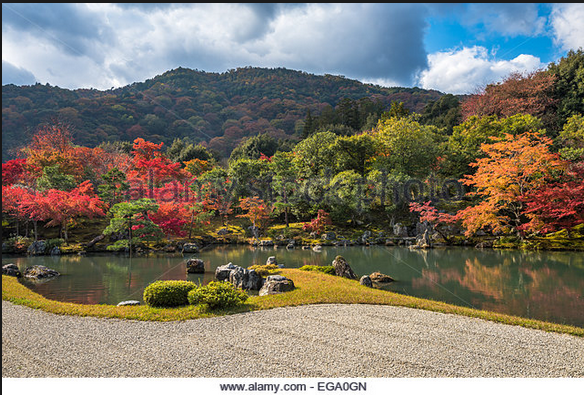 Shakkei (借景) is a term that refers to one of the three "types" of Japanese garden style: borrowed scenery. While Chinese in origin, one of the oldest examples of this arrangement that incorporates views of distant elements in the overall arrangement of the landscape features within a more immanent space is Sogenchi Teien (Sogen Pond Garden) at Tenryu-ji in Arashiyama.
 Many years ago, I found myself visiting Esalen, the retreat center situated on the rugged Pacific Coast off PCH (Pacific Coast Highway) in Big Sur (south of Monterey CA). The sources of water are both salt and fresh. The waves crash against the coastal boulders with great dramatic effects of splashing, loud impact; in the distance, the sea level swells hypnotically. On the other hand, Esalen has been renown for its mineral springs since the indigenous people first inhabited the land. Soaking naked and silent in the cliff-side tubs of hot water under a full moon with the sparkling waves hundreds of feet below is one of the not-to-be-forgotten life experiences.


