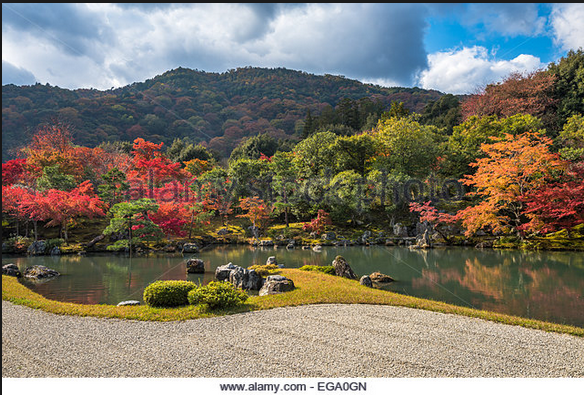
 Shakkei (借景) is a term that refers to one of the three "types" of Japanese garden style: borrowed scenery. While Chinese in origin, one of the oldest examples of this arrangement that incorporates views of distant elements in the overall arrangement of the landscape features within a more immanent space is Sogenchi Teien (Sogen Pond Garden) at Tenryu-ji in Arashiyama.
I was delighted to be reminded of this idea when I was reflecting on my practice of "shadow-boxing" temae practice; going through the upper body gestures of a temae without the benefit of having the correct context -- including dogu, room, guest, fire/water, etc. -- whether seated or walking. Some times I even imagine this process without the benefit of actual movement.
 Many years ago, I found myself visiting Esalen, the retreat center situated on the rugged Pacific Coast off PCH (Pacific Coast Highway) in Big Sur (south of Monterey CA). The sources of water are both salt and fresh. The waves crash against the coastal boulders with great dramatic effects of splashing, loud impact; in the distance, the sea level swells hypnotically. On the other hand, Esalen has been renown for its mineral springs since the indigenous people first inhabited the land. Soaking naked and silent in the cliff-side tubs of hot water under a full moon with the sparkling waves hundreds of feet below is one of the not-to-be-forgotten life experiences.
The atmosphere of this famed place of meditation, contemplation, education and deeply beautiful natural vistas and resources, is fully connected with that of the practice of temae.
I was at Esalen as a private guest, not participating in the many programs offered, but with full access to the baths, hiking, dining, dormitory facilities and the peacefulness of the natural landscape.


